• About
  • Partners
  • Glossary
  • Email
  • Twitter

Understanding Global Change

Discover why the climate and environment changes, your place in the Earth system, and paths to a resilient future.

Understanding Global Change

Discover why the climate and environment changes, your place in the Earth system, and paths to a resilient future.

Menu
  • Home
  • How to use this website
  • What is Global Change?
    • Close
    • Understanding Global Change 101
    • Understanding Global Change Infographic
    • How the Earth System Works
      • Atmosphere
      • Biosphere
      • Elemental Cycles
      • Geosphere
      • Global Energy Budget
      • Hydrosphere
    • Causes of Global Change
      • Human causes
      • Non-human causes
    • Measurable Changes
      • Atmosphere
      • Biosphere
      • Geosphere
      • Hydrosphere
      • Quality of human life
      • Weather / extreme events
    • Close
  • Teaching Resources
    • Close
    • Planning for Instruction
    • Example Units and Lessons
    • Downloadable Graphics
      • Infographic
      • Icon Sets
      • Earth Scene
    • Close
  • Construct a Model
Home → What is Global Change → Causes of Global Change → Non-human causes

Non-human causes

Rapid non-human causes change, such as meteorite impacts and major volcanic eruptions are rare, but when they do happen they can have catastrophic consequences throughout the Earth system. Some of the non-human causes of change affect the Earth on timescales of tens of thousands to millions of years, such as variation in Earth’s spin, tilt, and orbit, or changes in the distribution of continents and oceans, and do not explain the rapid global changes we are observing today. To learn more about rapid global changes happening today, visit the human causes of change page.

Click the icons below to learn more about the non-human causes of global change. Each page links to related topics on the UGC Infographic.
  • All
  • Human causes
  • Non-human causes

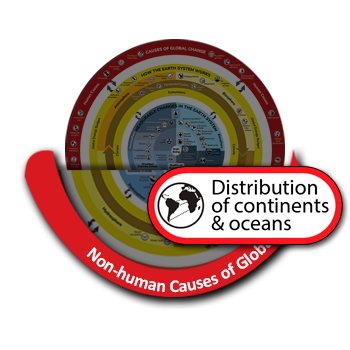
UGC infographic that highlights the distribution of oceans and continents as non-human causes of global change. Click to see full infographic.

Distribution of continents and oceans

UGC infographic that highlights Earth's spin, tilt, and orbit as non-human causes of global change. Click to see full infographic.

Earth’s spin, tilt and orbit

UGC infographic that highlights meteorite impacts as non-human causes of global change. Click to see full infographic.

Meteorite impact

UGC infographic that highlights mountain building as a non-human cause of global change. Click to see full infographic.

Mountain building

Graph plotting sunspot number between the years 1610 and 2010. There is no overall increase or decrease in the number of sunspots over the entire period. Instead, the number of sunspots cycles on an approximately yearly basis, with a low point between zero and 10 and a high point between roughtly 100 and 300 each cycle. However, the Maunder Minimum (1650-1710) is a time period with very few sunspots (often near zero).

Volcanism

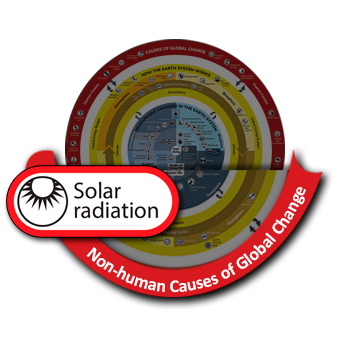
UGC infographic that highlights solar radiation as a non-human cause of global change. Click to see full infographic.

Solar radiation

A project of the University of California Museum of Paleontology  |  © 2026 University of California Regents. All Rights Reserved.