Approximately 75% of the Earth’s surface is covered by liquid water and ice (H2O). Water is constantly moving between the atmosphere, land, and ocean, shaping our planet’s climate and ecosystems. Water stores and exchanges heat among different parts of the Earth system, and is essential to all life on Earth. Human population growth, especially over the last century, has increased the extraction and use of water, which in turn reduced freshwater availability in many regions, both for human consumption and for ecosystems. Additionally, global warming alters how water cycles through the Earth system and changes the patterns of atmospheric circulation, both of which contribute to the frequency and severity of droughts and flooding events.
On this page:
- What is the water cycle?
- Earth system model of the water cycle
- Explore the Earth System
- Links to Learn More
For the classroom:
Global Change Infographic
The water cycle is an essential part of How the Earth System Works. Click the image on the left to open the Understanding Global Change Infographic. Locate the water cycle icon and identify other Earth system processes and phenomena that cause changes to, or are affected by, the cycling of water.
What is the water cycle?
Most water cycles through the Earth system because of energy from the Sun. Water absorbs sunlight. The increased energy increases the vibrations of the liquid water molecules, increasing the number of them that escape to become water vapor (which is a gas); thus the water evaporates. Evaporation transfers heat from the surface of the Earth (land and ocean) into the atmosphere. Ninety percent of the water in the atmosphere comes from evaporation, with the other 10% coming from the release of water vapor by plant leaves (called transpiration). Warmer air can hold more water than cooler air – water makes up from 0.2% of air mass in dry regions to up to 3% of air mass in tropical regions.
Water is the most abundant greenhouse gas (a gas that absorbs and re-radiates heat) in Earth’s atmosphere. However, on average water molecules only stay in the atmosphere for about nine days before falling back to Earth as rain or snow (precipitation). This amount of time that water spends in the atmosphere (called its residence time) is considerably shorter than the atmospheric residence time of other greenhouse gases, especially those contributed by the burning of fossil fuels (e.g., carbon dioxide and nitrous oxide), which remain in the atmosphere from decades to hundreds of years. For this reason, these greenhouses gases are the primary cause of overall warming of our planet today even though they are less abundant than water in the atmosphere. Warming can lead to more evaporation, which in turn, results in additional warming. This amplification of the initial warming is called a feedback loop.
| Water Reservoir | Average Residence Time |
|---|---|
| Ice caps | 10,000 to 200,000 years |
| Deep groundwater | 3,000 to 10,000 years |
| Oceans and inland seas | 3,000 to 3,500 years |
| Shallow groundwater | 100 to 200 years |
| Valley glaciers | 20 to 100 years |
| Freshwater lakes | 50 to 100 years |
| Winter snow | 2 to 6 months |
| Rivers and streams | 2 to 6 months |
| Soil moisture | 1 to 2 months |
| Atmosphere | 5 to 15 days |
| Living organisms | Hours to days |
The distribution of water (left) and the average residence times of water (right) in the Earth system. Adapted from Marshak (2018) Earth: Portrait of a Planet
As water evaporates from the surface of the Earth it rises, cools, and condenses into clouds, to later fall as precipitation. Atmospheric circulation, the large-scale movement of air, which we experience as the wind, transports water vapor around the globe, controlling when and where precipitation occurs. Precipitation enters the ice caps in polar regions, the ocean, lakes, rivers, or glaciers, can be absorbed by plants and animals, or percolate into the soil or deeper into the ground. Water that falls as snow and ice that forms glaciers and ice caps can remain there for hundreds to hundreds of thousands of years. Water molecules in the ocean can circulate for three thousand years, while water may only spend 2-6 months in rivers and streams, and hours to days in living organisms. However, even the water that enters the ground, where it can stay for hundreds to tens of thousands of years, eventually returns to the surface, where it can evaporate again, completing the cycle. Volcanoes also return water stored in rocks to the surface of the Earth as steam and water vapor.

A simplified diagram showing the movement of water through the Earth system
The rate and distribution of water cycling through the Earth’s surface affects various human activities and environmental phenomena, including:
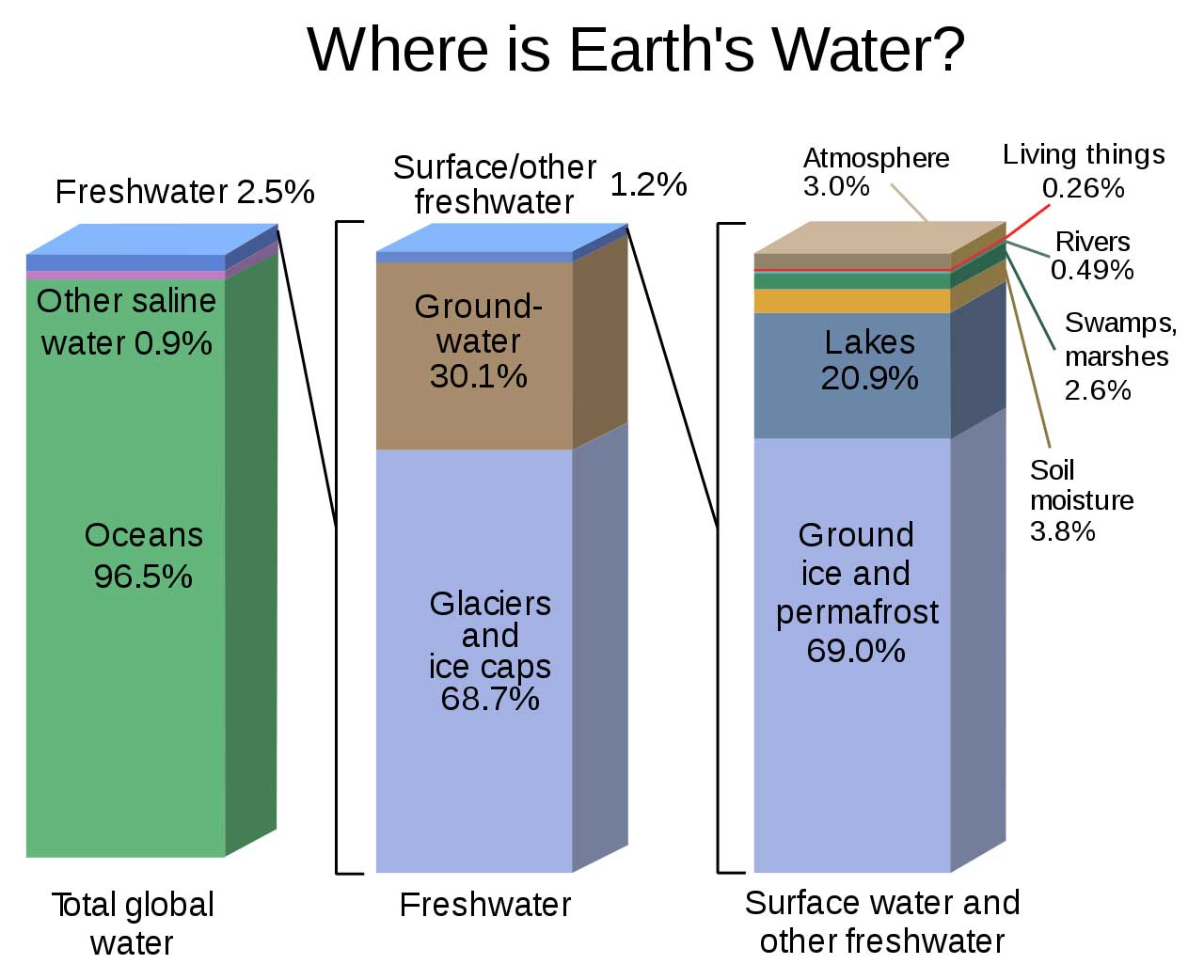
Earth’s water distribution. Source: Wikipedia
- Cloud cover and the frequency, intensity, and distribution of precipitation
- The re-radiation of heat in the atmosphere and thus the intensity of the greenhouse effect.
- Snow and ice cover, which affects various processes including the amount of sunlight reflected from the surface of the Earth (and thus the local temperature), species ranges, and sea level.
- Freshwater quality and availability for humans and other organisms.
- Productivity and biomass, species ranges, and biodiversity in all land ecosystems, and in turn human fishing and hunting and agricultural activities.
- Rates of weathering, erosion, and sedimentation.
- Ocean circulation patterns, especially as large volumes of freshwater enter the ocean due to melting caused by global warming, which can weaken the strength of vertical ocean currents.
- The severity of extreme weather events. For example, increased evaporation from warmer oceans and increased atmospheric temperatures can increase the frequency and severity of droughts, hurricanes, or flooding events.
Earth system model of the water cycle
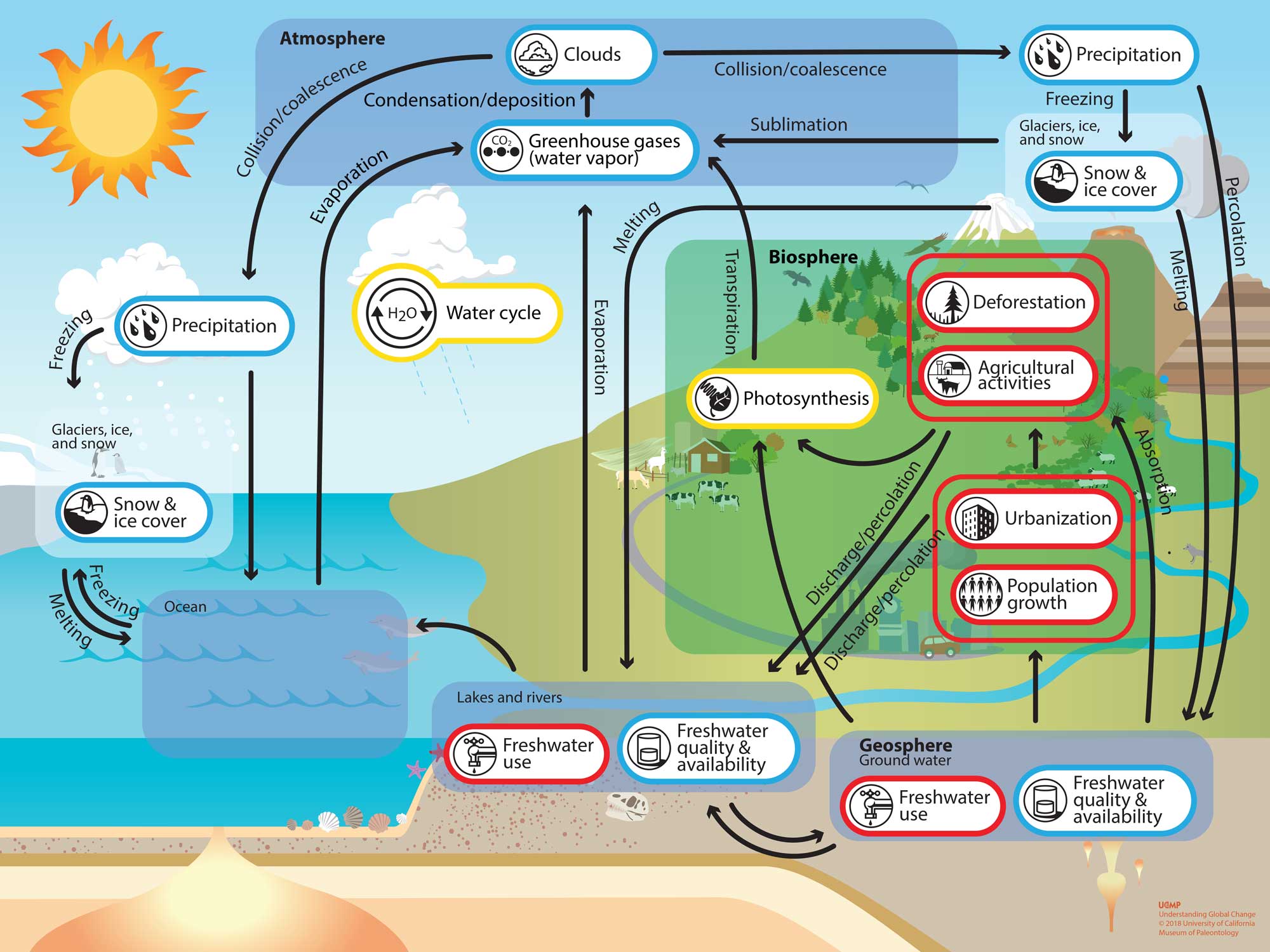
The Earth system model below includes some of the processes and phenomena related to the water cycle. These processes operate at various rates and on different spatial and temporal scales. For example, precipitation events affect particular regions over relatively short time periods (hours to weeks), but the human extraction of water from the environment for cities or for use in agriculture can alter entire ecosystems for years, decades, or longer. Can you think of additional cause and effect relationships between the parts of the water cycle and other processes in the Earth system?
Some of the processes and phenomena related to the water cycle
Explore the Earth System
Click the icons and bolded terms (e.g. freshwater use, greenhouse effect, and precipitation) on this page to learn more about these process and phenomena. Alternatively, explore the Understanding Global Change Infographic and find new topics that are of interest and/or locally relevant to you.